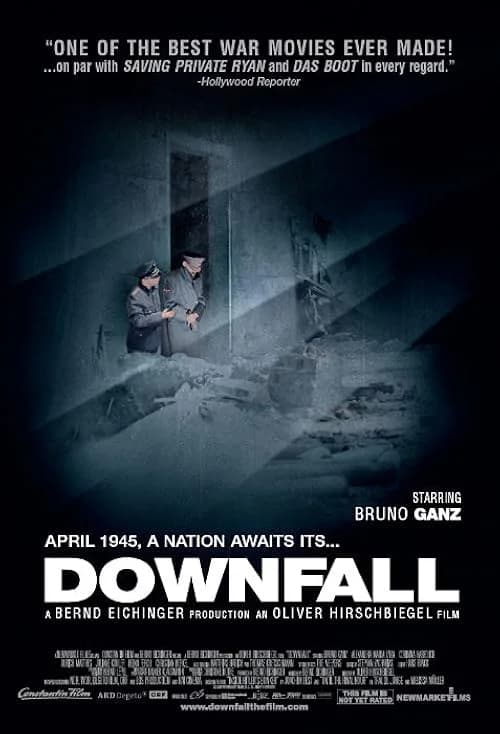
About Downfall
Downfall (German: Der Untergang) is a powerful 2004 historical drama that offers an unflinching look at the final days of Adolf Hitler's regime in the claustrophobic Berlin bunker. Directed by Oliver Hirschbiegel, the film is based on historian Joachim Fest's book and the memoirs of Traudl Junge, Hitler's personal secretary during his last moments. The narrative unfolds through Junge's perspective as the Third Reich collapses around them in April 1945.
Bruno Ganz delivers a career-defining performance as Hitler, portraying the dictator's descent from delusional optimism to explosive rage and ultimate resignation with terrifying authenticity. The supporting cast, including Alexandra Maria Lara as Junge and Ulrich Matthes as Joseph Goebbels, creates a chilling ensemble portrait of fanaticism and denial. Hirschbiegel's direction maintains remarkable tension despite the confined setting, balancing intimate character moments with the catastrophic historical context.
What makes Downfall essential viewing is its refusal to caricature evil. Instead, it presents Hitler and his inner circle as frighteningly human, making their actions and ideology all the more disturbing. The film doesn't seek to elicit sympathy but to understand the mechanics of power, loyalty, and self-deception at history's darkest hour. For anyone interested in WWII history, psychological drama, or masterful filmmaking, Downfall remains one of cinema's most compelling examinations of tyranny's end.
Bruno Ganz delivers a career-defining performance as Hitler, portraying the dictator's descent from delusional optimism to explosive rage and ultimate resignation with terrifying authenticity. The supporting cast, including Alexandra Maria Lara as Junge and Ulrich Matthes as Joseph Goebbels, creates a chilling ensemble portrait of fanaticism and denial. Hirschbiegel's direction maintains remarkable tension despite the confined setting, balancing intimate character moments with the catastrophic historical context.
What makes Downfall essential viewing is its refusal to caricature evil. Instead, it presents Hitler and his inner circle as frighteningly human, making their actions and ideology all the more disturbing. The film doesn't seek to elicit sympathy but to understand the mechanics of power, loyalty, and self-deception at history's darkest hour. For anyone interested in WWII history, psychological drama, or masterful filmmaking, Downfall remains one of cinema's most compelling examinations of tyranny's end.