About The Miracle Worker
The Miracle Worker (1962) stands as one of cinema's most powerful biographical dramas, chronicling the extraordinary true story of Helen Keller and her teacher Anne Sullivan. Directed by Arthur Penn, this film adaptation of William Gibson's play captures the intense, often physically demanding struggle to reach a child trapped in isolation. The story follows Sullivan's arrival at the Keller household, where she confronts the seemingly impossible task of teaching young Helen, who is blind, deaf, and mute, how to understand language and connect with the world around her.
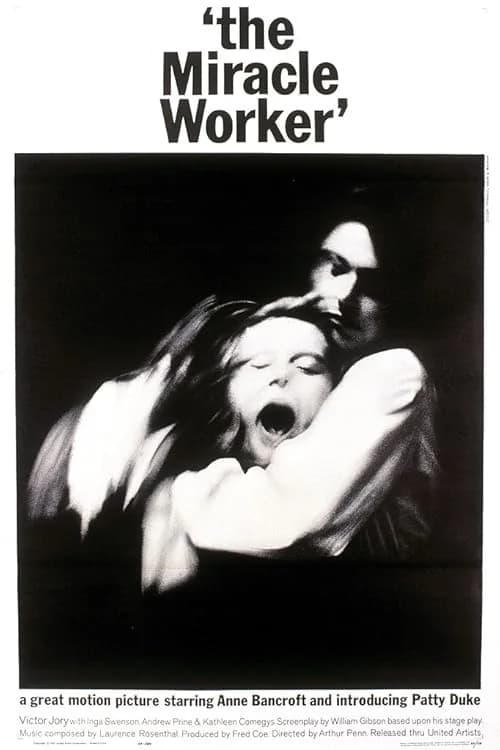
The film's brilliance lies in its raw, uncompromising portrayal of this educational battle. Anne Bancroft, reprising her Tony-winning stage role as Anne Sullivan, delivers a performance of fierce determination and compassion. Patty Duke, as young Helen Keller, gives a staggering, physically committed portrayal that remains one of the most remarkable child performances ever captured on film. Their scenes together—particularly the famous breakthrough at the water pump—are cinematic landmarks of emotional power.
Arthur Penn's direction masterfully balances intimacy with intensity, using tight framing and stark black-and-white cinematography to immerse viewers in Helen's sensory world before her awakening. The film avoids sentimentality, instead presenting a gritty, realistic struggle that makes the eventual breakthrough all the more triumphant. Winner of two Academy Awards, The Miracle Worker remains essential viewing not just for its historical significance, but for its timeless exploration of human perseverance, communication, and the transformative power of education. It's a profoundly moving experience that continues to inspire audiences six decades later.
The film's brilliance lies in its raw, uncompromising portrayal of this educational battle. Anne Bancroft, reprising her Tony-winning stage role as Anne Sullivan, delivers a performance of fierce determination and compassion. Patty Duke, as young Helen Keller, gives a staggering, physically committed portrayal that remains one of the most remarkable child performances ever captured on film. Their scenes together—particularly the famous breakthrough at the water pump—are cinematic landmarks of emotional power.
Arthur Penn's direction masterfully balances intimacy with intensity, using tight framing and stark black-and-white cinematography to immerse viewers in Helen's sensory world before her awakening. The film avoids sentimentality, instead presenting a gritty, realistic struggle that makes the eventual breakthrough all the more triumphant. Winner of two Academy Awards, The Miracle Worker remains essential viewing not just for its historical significance, but for its timeless exploration of human perseverance, communication, and the transformative power of education. It's a profoundly moving experience that continues to inspire audiences six decades later.